Where AI Genuinely Helps School Administration (and Where It Doesn’t)
A grounded look at AI for Indian school offices: answering questions from school data, drafting messages, spotting patterns — and the limits to set.
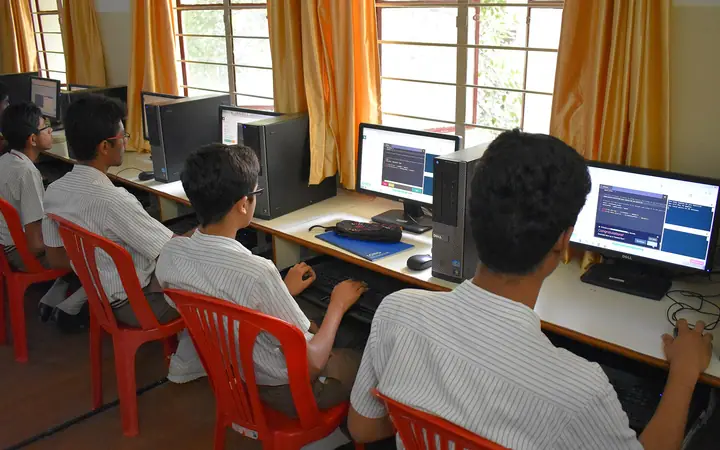
Photo: Nayakyashraj · CC BY-SA 4.0
Every school software vendor now mentions AI. Some of it is useful. Some of it is a chatbot bolted onto a menu. For a principal or school owner, the useful question is not “does it have AI?” but “which hour of my staff’s week does this give back?”
Where AI helps today
Answering questions from your own data
The most immediately useful AI in a school office is not one that writes essays — it is one that answers questions from the school’s own records:
- “How many students are absent today?”
- “Which classes have the lowest attendance this month?”
- “List fee defaulters above ₹20,000.”
- “Summarise today’s campus activity.”
Without AI, each of these means finding the right report, setting filters and reading a table. With an assistant that understands the question — including how Indian schools talk about money, in lakhs and terms — it takes seconds, and the principal can ask it from a phone between meetings.
This is what SIA, the SchoolKonnect Intelligence Assistant, is built for. Its answers come from live school data, it respects the permissions of the person asking, and every answer links to the screen where you can act on it.
Drafting, not deciding
AI is good at a first draft: a circular, a polite fee reminder, a summary of a long policy. It saves the blank-page minutes. A human should always read and approve what goes to parents.
Spotting patterns early
A student whose attendance is slowly falling, a class whose marks dropped sharply between terms, a bus route that is regularly late — these patterns are visible in data long before they are visible in the staff room. Software can surface them; people decide what to do.
Helping new staff find their way
New office staff spend their first weeks asking “where do I find…?”. Guided tours and plain-language search inside the system shorten that learning curve considerably.
Where AI does not help — or needs care
- Decisions about individual children. Admissions, promotions, discipline and support decisions need human judgement and accountability.
- Anything it cannot see. An assistant can only answer from data that exists. If attendance is not being marked, no AI will tell you who is absent.
- Confident wrong answers. General-purpose AI tools can produce plausible but incorrect answers. Prefer tools that answer from your records and show where the figure came from.
- Children’s data in public tools. Copying student lists or marks into a public AI chatbot may breach your school’s obligations under the DPDP Act. Use tools that keep data inside your school’s system.
Rules worth setting
- AI may draft; a person approves anything sent to parents.
- No student data goes into public AI tools.
- AI answers must respect the same access rules as the rest of the system.
- Decisions about individual students are made by people.
The bottom line
The best use of AI in a school office is quiet and practical: fewer reports to build, faster answers, earlier warnings. It works only on top of clean, complete data — which is why the foundation is still a single system for attendance, fees, exams and communication.
Ask us for a demo and try SIA on a demo school’s data.